Webb observations reveal a supergiant's merger with a smaller star
Researchers studying the aftermath in Andromeda say the two stars merged after seven final orbits, leaving an object nicknamed Bao.
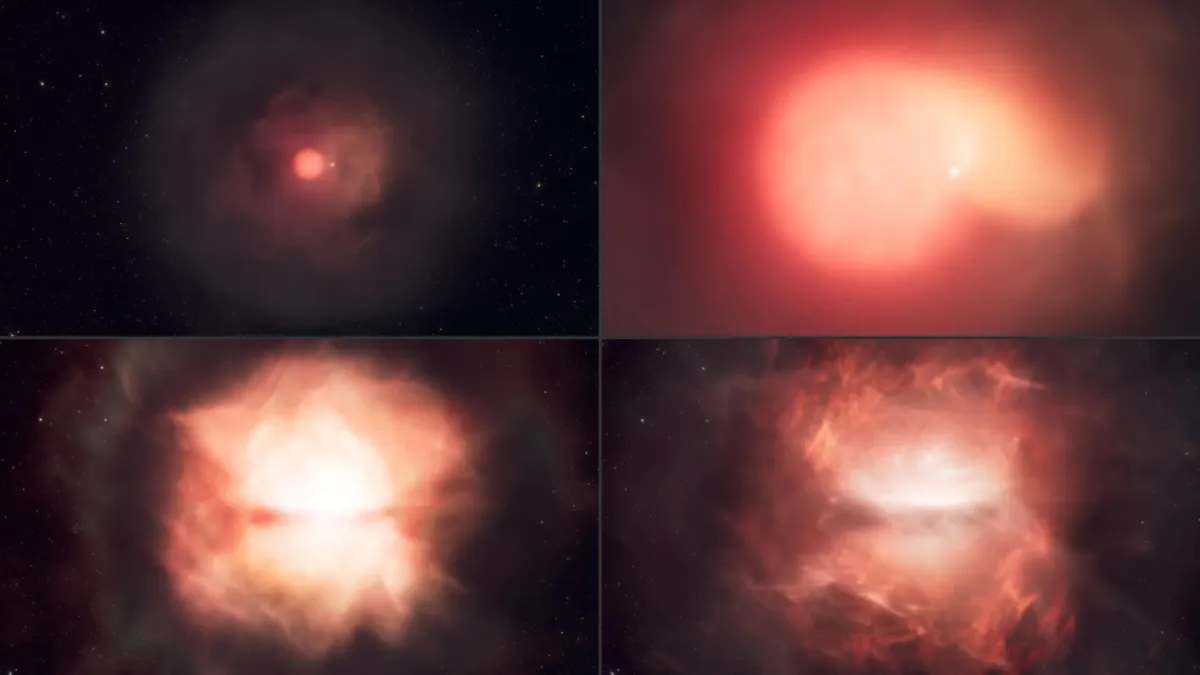
Astronomers have identified a stellar merger near Andromeda's outer edge, finding that a supergiant engulfed its smaller companion and became a single star. The NASA-funded team used James Webb Space Telescope observations and other telescope records to reconstruct the encounter, described in a paper in Nature.
The resulting object, officially designated AT 2025abao and nicknamed Bao, erupted in 2025. Webb examined it on December 24, 2025, just 47 days after its brightness peaked. Lead author Viraj Karambelkar, a NASA Hubble Fellow at Columbia University, said this was the earliest follow-up observation of such an event.
The researchers found that the pair had orbited each other for thousands of years before the smaller star began interacting with the supergiant's outer atmosphere. From that point, the merger took only seven more orbits, or about seven years. Previously observed mergers of smaller stars took thousands of orbits.
The interaction involved what astronomers call common envelope evolution, in which both stars occupy a shared layer of gas. Resistance within that gas slowed the companion's orbit, drawing it inward. Although simulations initially suggested it might escape, further investigation showed it had plunged into the giant's core.
Webb's mid-infrared data revealed dust expelled over hundreds of years. Combined with simulations, the observations helped researchers estimate the smaller star's mass at about 0.7 solar masses. Earlier telescope records also captured changes in brightness and dust production before the eruption. Bao's current internal structure and mass distribution remain uncertain, requiring further observations.