
Rubin Observatory finds a faint galaxy and star cluster orbiting the Milky Way
Researchers identified the two satellites in preview observations covering about 7% of the night sky.
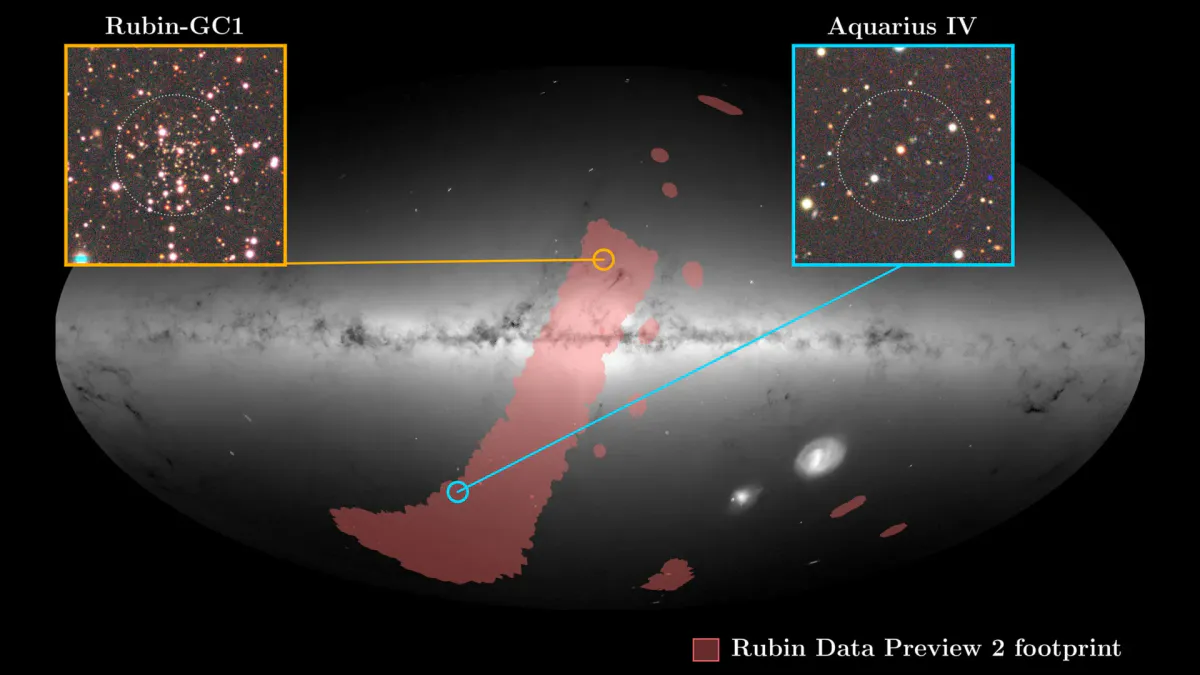
Astronomers have discovered two previously unknown Milky Way satellites using early observations from Chile’s Vera C. Rubin Observatory. The objects are Aquarius IV, a small galaxy approximately 355,000 light-years from Earth, and Rubin-GC1, a star cluster obscured by cosmic dust.
The researchers searched images taken between April 2025 and January 2026, covering about 7% of the night sky. Rubin-GC1 lies on the opposite side of the Milky Way, in an area where dense dust clouds make it difficult to observe.
William Cerny, an astronomy student at Yale’s Graduate School of Arts and Sciences, led the Aquarius IV research, published in Research Notes of the AAS. Aashay Pai of the University of Chicago led the Rubin-GC1 study, which The Astrophysical Journal Letters has accepted for publication. Cerny is also its second author.
Astronomers have identified approximately 65 galaxies that are satellites of the Milky Way. Some estimates put the number still undetected in the hundreds. Cerny said further discoveries would offer opportunities to examine galaxy formation, reconstruct the Milky Way’s assembly and investigate dark matter.
Rubin’s 10-year Legacy Survey of Space and Time aims to document changes in the night sky and map the halo surrounding the Milky Way’s main disk. The observatory uses an 8.4-meter telescope and a camera with 3.2 gigapixels of resolution. Its funding comes jointly from the National Science Foundation and the U.S. Department of Energy’s Office of Science.