
Experiments show magma can store extra oxygen under pressure
Laboratory findings suggest molten rock could carry oxygen from Earth's interior, but its contribution to the atmosphere remains unproven.
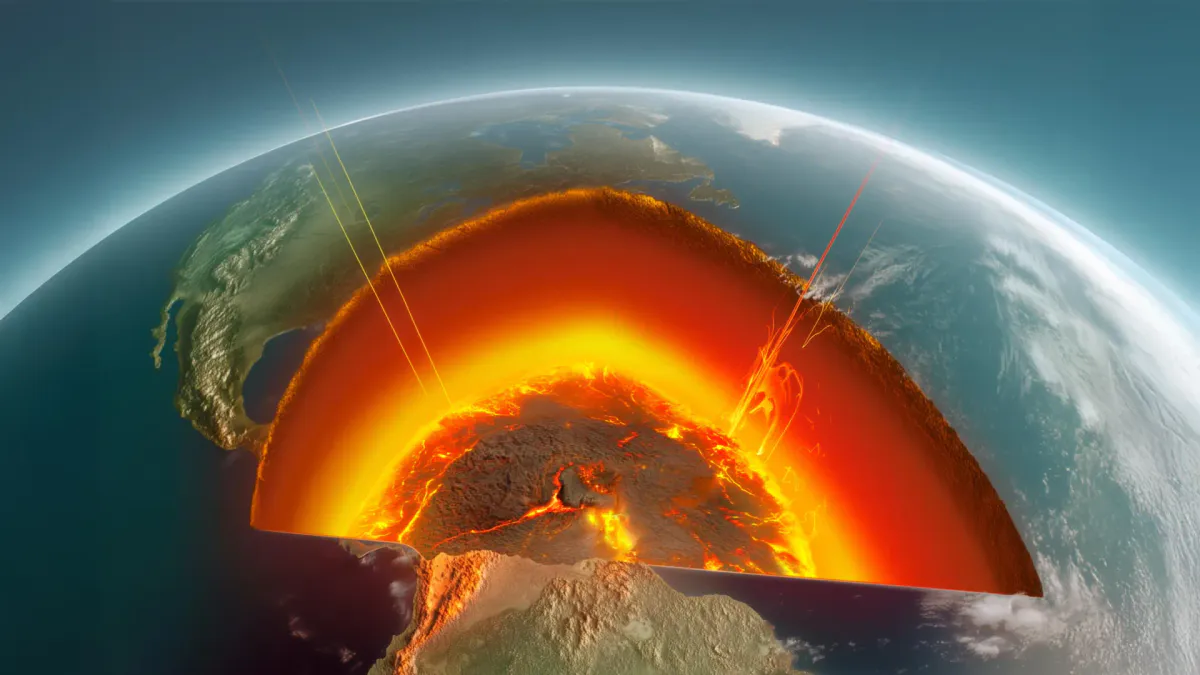
Molten rock can incorporate oxygen beyond the quantity predicted by its chemical composition, researchers found in laboratory experiments and computer simulations. At 7 gigapascals, excess oxygen represented more than 5% of an experimental sample's weight, suggesting a possible route for oxygen to move from Earth's interior toward its surface.
The study, published in National Science Review, was led by Dr. Yanhao Lin and Dr. Ho-kwang Mao at the Center for High Pressure Science and Technology Advanced Research, alongside researchers from Northwestern Polytechnical University and Vrije Universiteit Amsterdam.
The team heated synthetic mid-ocean ridge basalt at temperatures between 1200 and 1800 °C, using platinum oxide to create oxygen-rich conditions. After cooling the melt into glass, they measured its composition to estimate oxygen not accounted for by other elements, water or carbon dioxide.
Samples tested at atmospheric pressure held almost no excess oxygen. Tests without added platinum oxide yielded only 0.2% to 0.5% by weight under similar pressure and temperature conditions. Spectroscopy detected no oxygen gas in the glass, indicating that the additional oxygen was incorporated into its structure rather than trapped in bubbles.
Simplified computer models also showed greater oxygen storage as pressure rose. The researchers propose that ascending magma could release oxygen as pressure falls, potentially influencing the crust and atmosphere. However, the findings do not establish how much oxygen natural magma contains or how much reaches the atmosphere.