Euclid identifies 31 ancient quasars, including two age record-setters
The discoveries include faint objects missed by earlier searches and draw on a survey intended to examine more than one-third of the sky.
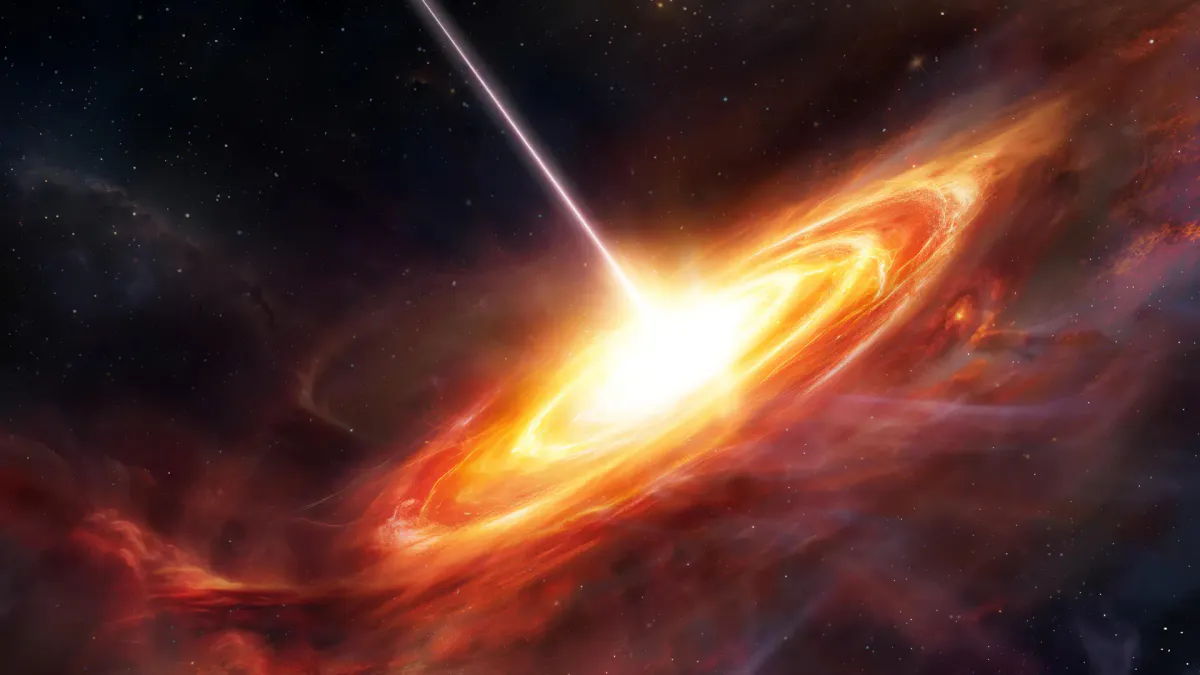
Astronomers have found 31 ancient quasars using Euclid, the European Space Agency’s space telescope. Two are the earliest examples yet observed, emitting light before the universe reached 670 million years of age, according to the discovery team.
The researchers measured a redshift of 7.77 for EUCL J172902.75+641018.1 and 7.69 for EUCL J125308.55+705432.3. Each is just over 13 billion light-years away. The former record-holder, found in 2021, registered 7.64.
Redshift describes the stretching of light during cosmic expansion, allowing astronomers to estimate distance and trace when the light originated. The newly discovered group includes 12 objects with redshifts reaching or exceeding 7, placing their light within cosmic history’s first 770 million years.
Quasars are intensely bright galaxy cores fueled by matter spiraling toward supermassive black holes. Daming Yang of Leiden University in the Netherlands, the discovery paper’s lead author, said investigating these objects could clarify how such massive systems developed so rapidly. Euclid can detect dimmer examples that proved difficult for previous searches.
Silvia Belladitta and colleagues separately studied the second-oldest object in the newly identified group. Their observations showed a host galaxy rich in gas and dust, with rapid star formation. The full set of 31 discoveries came from the Euclid Wide Survey, whose eventual coverage will exceed one-third of the sky.