
Ancient eclipse record helps refine estimates of Earth's rotation
Researchers corrected the location of an ancient Chinese court to reconstruct a 709 BCE eclipse, while a later account offered possible clues to solar activity.
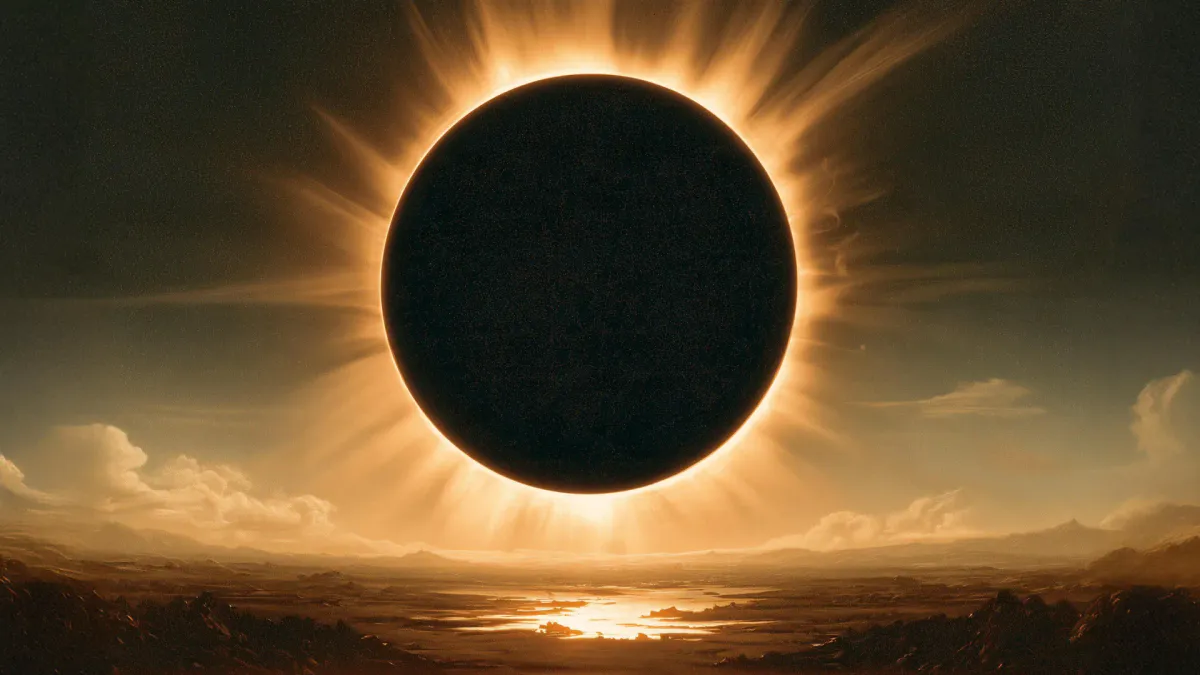
An international team has refined estimates of Earth's ancient rotation by reconstructing the total solar eclipse of July 17, 709 BCE, after correcting a geographic error involving Qufu, the capital of China's Lu Duchy. The findings appeared in Astrophysical Journal Letters.
Earlier calculations suggested the eclipse would not have been total at the court's assumed location. Using archaeological reports and historical geographic evidence, the researchers found that previous work had placed ancient Qufu approximately eight kilometers away from its actual position.
With that correction, the team calculated a range of 20,264 to 21,204 seconds for delta T (ΔT), which measures differences between Earth's rotation and a uniform time scale. The researchers said the findings improve constraints on rotation during the eighth through sixth centuries BCE and could help reconstruct other historical astronomical events.
The eclipse was documented in the Spring and Autumn Annals, compiled approximately 200 to 300 years afterward. A separate passage preserved in the Hanshu, written about seven centuries after the event, may describe the solar corona—the Sun's faint outer atmosphere.
According to the team, the possible corona description is consistent with renewed solar activity after an extended quiet period lasting approximately 808 to 717 BCE. It also agrees with earlier reconstructions based on radiocarbon in tree rings. However, the researchers cautioned that the later account's interpretation remains uncertain and does not provide definitive proof.