Mars study revises dust estimates for northern polar ice
Researchers estimate that exposed older ice contains closer to 3% dust, compared with earlier estimates of up to 25% by mass for the uppermost polar ice.
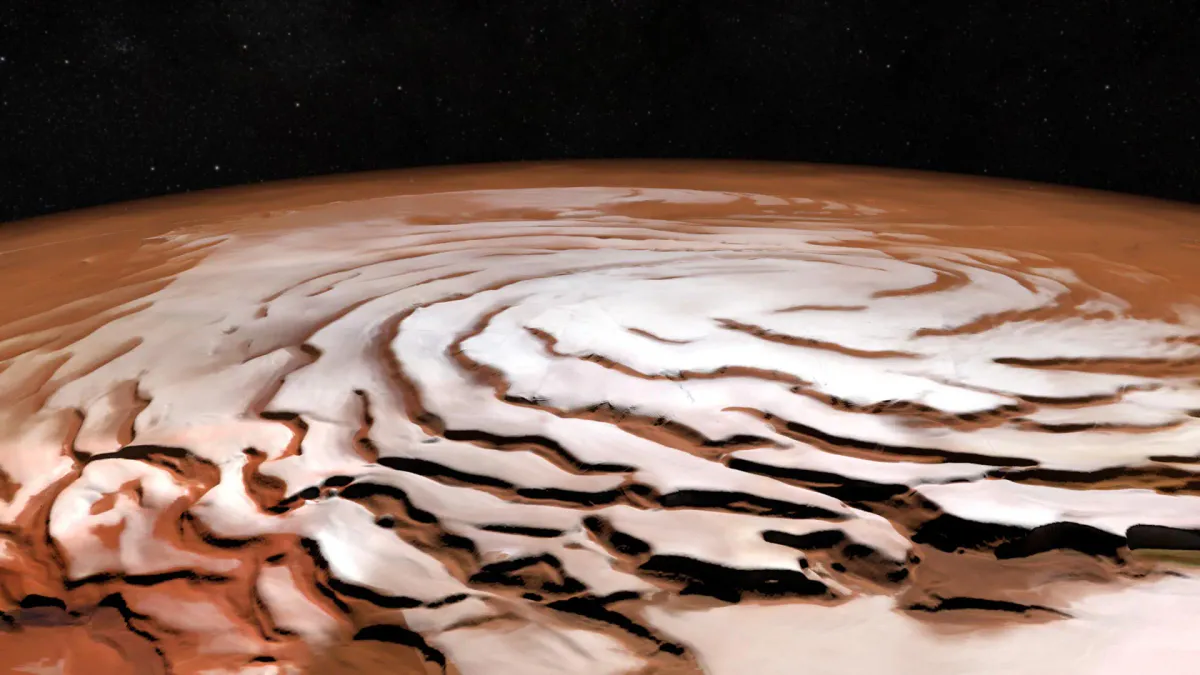
A University of Washington team has concluded that exposed older ice around Mars’ north pole is substantially cleaner than previous estimates suggested. Its revised analysis places the dust content closer to 3%; earlier calculations allowed for as much as 25% by mass in the uppermost polar ice.
The study, appearing in npj Space Exploration, draws on data gathered by NASA’s Phoenix mission in 2008 alongside spacecraft observations from orbit. Aditya Khuller, a senior research scientist at the university’s Applied Physics Laboratory, and recent geoscience graduate Pari Mohan adapted techniques used to investigate snow and ice on Earth. The commonly used approach had originally been developed for lunar soil.
The team’s findings describe thicker stretches of cleaner ice separated by relatively dusty layers. Khuller said changes in brightness over time showed that dustier frost collects in winter, then disappears during the Martian summer to reveal older, cleaner ice. Dust makes ice darker, causing it to absorb more sunlight, warm up and vaporize faster, he said.
Scientists believe snowfall thousands of years ago produced these deposits, which may preserve evidence of past climate conditions. Khuller hopes to use the revised techniques to investigate ice in other regions of Mars.