
Scans challenge reptile identity of 345-million-year-old fossil
Researchers found internal gills and thousands of tiny teeth, suggesting the Scottish fossil belonged to an aquatic or amphibious animal.
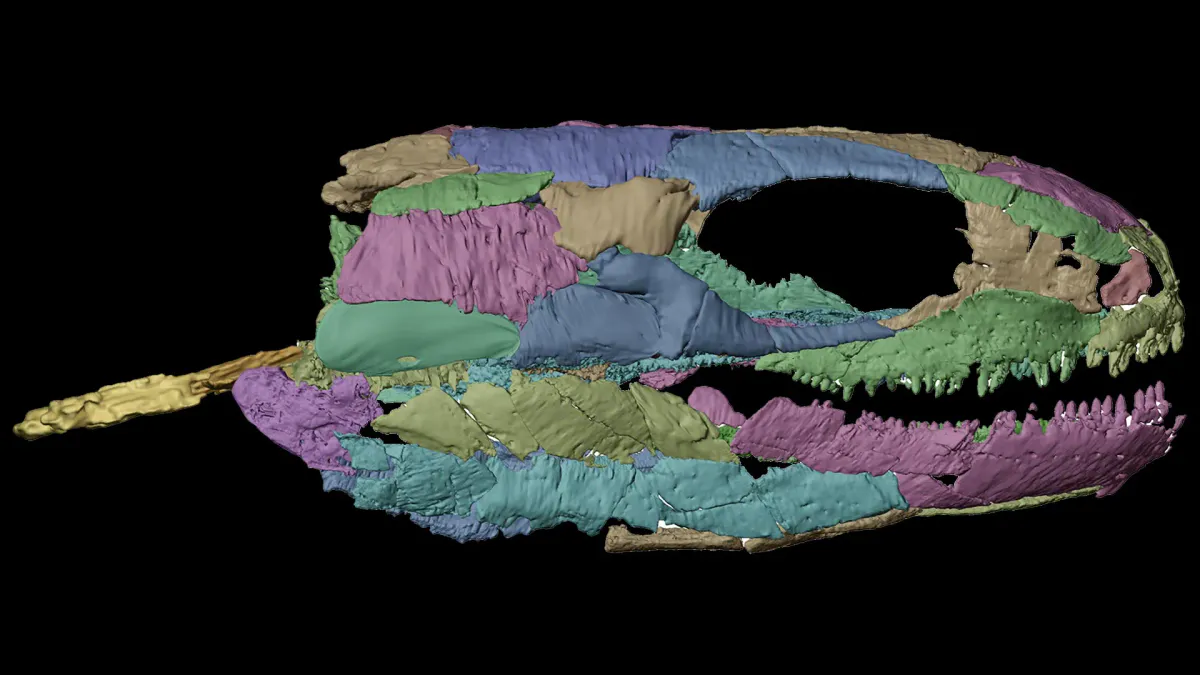
A 345-million-year-old fossil from Scotland long considered an early reptile instead appears to represent an aquatic or amphibious animal, according to research published in Nature. X-ray scans revealed anatomy inconsistent with its proposed position in the lineage leading to reptiles, the researchers reported.
Scientists from the American Museum of Natural History and the University of Oxford led the study, collaborating with the European Synchrotron Radiation Facility in Grenoble, France. Imaging there allowed the team to reconstruct structures hidden within the rock, revealing a primitive skull, bony internal gills and a fishlike mouth containing thousands of tiny teeth.
The specimen, Westlothiana lizziae, was discovered in 1984 and nicknamed Lizzie. Its almost complete skeleton survives across two crushed rock slabs. Earlier interpretations largely depended on surface details, including limbs bearing fingers and toes with apparently clawlike ends. After its scientific description in 1990, it became a reference point for studying amniotes, the group encompassing mammals, reptiles and birds.
The findings suggest that claws and five-digit hands and feet emerged in earlier animals still associated with water, the researchers said. They also raise questions about ancient trackways attributed to amniotes: clawed footprints alone may not establish that identity, because more ancient amphibious relatives could have left similar impressions.