
Fire salamanders reveal fluorescent skin secretions under UV light
Researchers have yet to identify the substance producing the glow or determine whether it helps the amphibians communicate or deter predators.
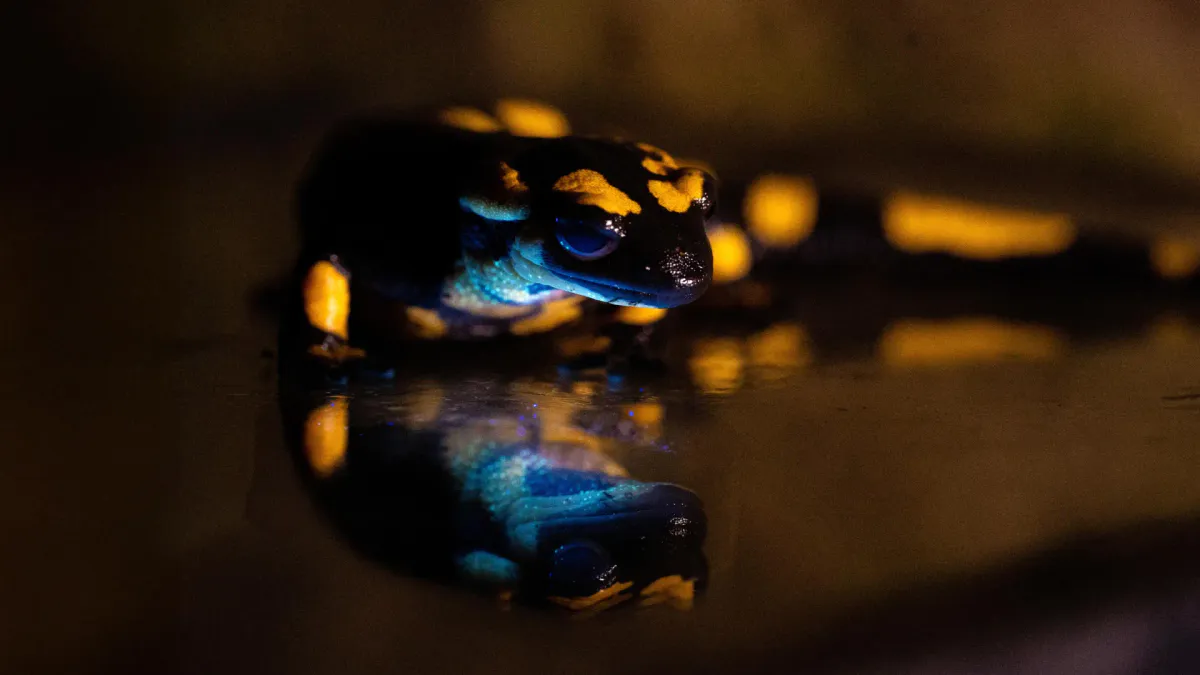
Scientists have detected fluorescence in fire salamanders, tracing most of the effect to skin glands and the material they secrete. According to the researchers, those secretions retain their fluorescent properties outside the body for more than 24 hours.
The brightest glow appears along the animals’ sides and yellow portions of their undersides. Compounds absorb ultraviolet light and release the energy in visible green and cyan wavelengths. This differs from bioluminescence, in which a chemical reaction generates light. Humans require a UV lamp to observe the salamanders’ fluorescence.
Its biological function remains unresolved. The team suggested it might support communication, including recognition or mate assessment, or reinforce the animals’ warning colors against predators. None of those possible roles has been established.
Researchers are working to identify the chemicals involved. Study co-author Salvador Carranza, a researcher at the IBE (CSIC-UPF), said the evidence suggests the fluorescent substance may be a molecule previously unrecognized in fire salamanders.
The work belongs to an amphibian conservation project in Catalonia supported by the Barcelona Zoo Foundation. The International Union for Conservation of Nature lists fire salamanders as vulnerable, and habitat destruction and fragmentation threaten the species.